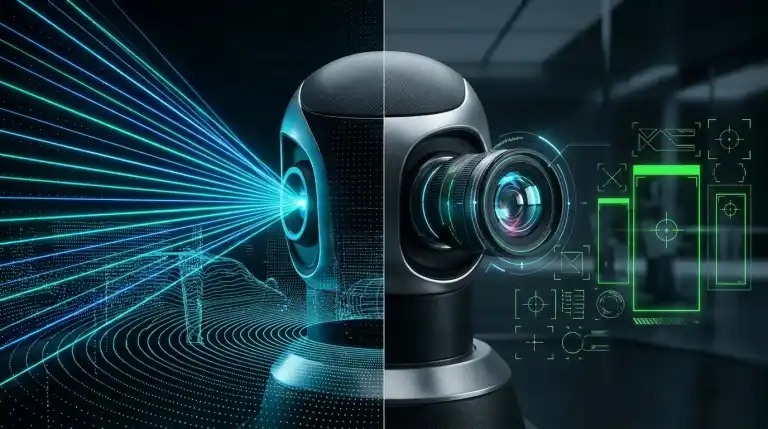
Learn how LiDAR and cameras help autonomous robots perceive their surroundings, navigate environments, avoid obstacles, and why modern robotics relies on sensor fusion.
Robots rely on sensors and artificial intelligence to perceive and navigate their physical surroundings with precision. While cameras capture rich visual details like color and texture, LiDAR uses laser pulses to measure exact distances in three-dimensional space. Understanding How Do Robots Recognize Objects? explains how sensory inputs and computer vision algorithms work together to guide autonomous machines.
The fundamental distinction between these two technologies comes down to two questions: LiDAR answers where an object is with millimeter accuracy, while cameras answer what that object is through semantic recognition. Understanding these trade-offs helps explain how modern vacuum robots, self-driving vehicles, and industrial warehouse machines make real-time navigational decisions.
What Is LiDAR in Robotics?
LiDAR stands for Light Detection and Ranging. It is an active remote sensing technology that emits rapid pulses of eye-safe infrared laser light to measure physical distance.
When a laser beam hits an obstacle, it bounces back to the sensor’s optical receiver. By calculating the Time of Flight (ToF)—the exact time it takes for the light pulse to travel to the object and return—the robot determines the distance with extreme accuracy.
Distance = (Speed of Light × Time of Flight) / 2
By firing hundreds of thousands of laser pulses per second, LiDAR generates a dense 3D point cloud. This point cloud serves as a metric blueprint of the room, allowing the robot to map walls, doorways, and furniture without guessing distances.
Mechanical vs. Solid-State LiDAR
In robotics, LiDAR hardware generally falls into two distinct categories:
- Mechanical LiDAR: Uses physically rotating mirrors, lasers, and photodiode arrays to sweep a 360-degree horizontal field of view. While common in robotic vacuums and early autonomous test vehicles, spinning components introduce mechanical wear, vibration sensitivity, and higher physical profiles.
- Solid-State LiDAR: Eliminates moving mechanical parts entirely by using micro-electromechanical systems (MEMS), optical phased arrays (OPA), or flash illumination. Solid-state LiDAR modules are significantly more compact, resistant to shock, durable over years of continuous operation, and affordable to mass-produce.
What Are Cameras and Computer Vision in Robotics?
Cameras in robotics are passive optical sensors that capture ambient visible or infrared light across digital CMOS image sensors. Unlike LiDAR, a standard optical camera does not emit its own light; it records 2D arrays of pixels containing color, patterns, and brightness.
To interpret what these images mean, robots rely on computer vision and deep learning convolutional neural networks (CNNs). Modern robotic camera setups generally fall into three categories:
- Monocular Vision: A single RGB camera that infers depth through motion perspective, optical flow, and AI depth-estimation models. It is the most cost-effective solution but requires significant compute power to estimate scale accurately.
- Stereo Vision: Dual cameras separated by a fixed baseline distance, mimicking human binocular vision to calculate depth through pixel disparity triangulation. Stereo cameras generate 3D depth maps without projecting active lasers.
- RGB-D (Structured Light / Active Depth): Combines standard RGB color sensors with an infrared projector that casts an invisible dot matrix onto surfaces. An infrared camera reads the grid’s deformation to generate instantaneous, millimeter-level depth maps at close ranges.
LiDAR vs Camera: Detailed Engineering Comparison
| Feature / Metric | LiDAR Sensors (ToF / Solid-State) | Optical Cameras (RGB / Stereo / RGB-D) |
|---|---|---|
| Sensor Modality | Active (Emits infrared laser pulses) | Passive (Detects reflected ambient light) |
| Primary Data Output | 3D Metric Point Cloud (X, Y, Z coordinates) | 2D Pixel Grids (Color, Texture) or Depth Maps |
| Operating Range | 0.1m to 25m (indoor) / up to 250m (automotive) | 0.2m to 50m (depth degrades with distance) |
| Low-Light Performance | 100% Effective (Works in pitch-black darkness) | Struggles (Requires ambient light or IR lamps) |
| Sunlight / Ambient Glare | High resistance (especially at 1550nm wavelength) | Prone to sensor saturation, blinding, and shadows |
| Object Identification (Semantics) | Low (Detects physical presence, not identity) | Superior (Classifies labels, text, wires, hazards) |
| Mapping & Localization (SLAM) | Rapid, millimeter-to-centimeter precision | Can drift on plain white, featureless walls |
| Detection of Thin / Low Objects | Can miss thin charging cables and flat objects | High (Neural networks recognize shapes visually) |
| Privacy Protection | High (Anonymous geometric point coordinates) | Low (Captures facial features, rooms, personal items) |
| Computational Processing Load | Low to moderate (Distance is directly calculated) | High (Requires GPU/NPU for neural inference) |
| Hardware Form Factor | Requires rotating turret or solid-state module | Ultra-compact, mounts flush on chassis |
| Manufacturing Cost | Moderate to High ($40 to $5,000+) | Low ($5 to $100 per sensor module) |
Key Technical Differences Between LiDAR and Camera
1. Metric Accuracy vs. Semantic Understanding
LiDAR produces ground-truth metric coordinates. When LiDAR scans a wall, the robot knows with mathematical certainty that an obstacle exists exactly 2.45 meters away. However, LiDAR cannot tell if an obstacle is an immovable brick wall, a glass door, or a hanging curtain.
Cameras excel where LiDAR is blind. An AI-powered camera recognizes that a small object on the floor is a power strip, a child’s toy, or pet waste, allowing the robot to intelligently reroute around hazards rather than bumping into them.
2. Environmental Lighting and Darkness
Because LiDAR generates its own laser illumination, ambient lighting has zero impact on its functionality. A warehouse AMR or robot vacuum equipped with LiDAR operates with identical accuracy in daylight and in complete darkness.
Standard optical cameras depend heavily on external lighting. In low-light environments, shadowy corridors, or under direct blinding solar glare, visual SLAM algorithms can lose feature tracking, causing the robot to drift or halt.
3. Obstacle Avoidance and Low-Profile Blind Spots
Traditional LiDAR turrets are mounted on top of robotic units to achieve a 360-degree horizontal field of view. Consequently, items located below the laser’s scanning horizon—such as loose cables, rugs, and low pet bowls—fall into a blind spot.
Cameras positioned on the front bumper have a wide field of view that extends down to the floor, enabling AI models to spot and avoid low-profile hazards that LiDAR sweeps right over.
4. LiDAR SLAM vs. Visual SLAM (vSLAM)
Simultaneous Localization and Mapping (SLAM) is the algorithmic engine that allows robots to construct a map and orient themselves inside it at the same time:
- LiDAR SLAM (Cartographer, Gmapping): Relies on the Iterative Closest Point (ICP) algorithm to match successive point cloud scans. Because metric distance is directly provided by the sensor, loop closure and map generation require minimal compute overhead and converge within seconds.
- Visual SLAM (ORB-SLAM, VINS-Mono): Tracks high-contrast visual keypoints (corners, edges, surface textures) across sequential video frames. In expansive indoor spaces with plain, untextured white walls, vSLAM algorithms struggle to find tracking landmarks, leading to scale ambiguity and navigational drift.
5. User Privacy and Data Security
In consumer homes, hospitals, and corporate office environments, cameras carry significant privacy concerns. Video feeds can accidentally record occupants, private documents, and confidential layouts, raising GDPR and data sovereignty compliance challenges.
LiDAR offers inherent privacy compliance. Because LiDAR records exclusively mathematical coordinates and distance points without color, facial features, or readable text, it is completely anonymous while maintaining full spatial awareness.
6. The Physics of Surface Reflection and Absorption
Both sensors encounter specific physical failure scenarios:
- Glass and Transparent Partitions: LiDAR laser pulses pass straight through clear glass without reflecting back, causing robots to perceive full-length windows as open hallways. Mirrors reflect laser pulses away at angles, creating phantom rooms.
- Deep Black Carpets: Ultra-dark materials can absorb near-infrared light at 905nm wavelengths. When an infrared drop sensor or LiDAR beam hits a deep black rug, the lack of reflected photons can trick the robot into thinking it has encountered a dangerous cliff edge, causing it to back away needlessly.
Real-World Applications: Where Each Sensor Wins
1. Robot Vacuums (Smart Cleaning)
Early robot vacuums that relied exclusively on top-mounted LiDAR frequently tangled themselves in charging cords. Modern premium vacuums solve this by pairing a top LiDAR dome for room navigation with a front AI camera for obstacle recognition.
2. Autonomous Vehicles (Waymo vs. Tesla)
- Waymo, Cruise, and Zoox: Use multi-sensor suites combining long-range 3D LiDAR, radar, and cameras for certified safety redundancy. Even if bright sunlight blinds forward cameras, LiDAR guarantees that an obstacle’s physical position is tracked.
- Tesla (Tesla Vision): Relies solely on optical cameras and deep neural networks, aiming to mimic biological human vision while minimizing sensor costs. However, edge-case camera perception in blinding rain, blizzards, and direct solar glare continues to challenge pure-vision systems.
3. Industrial AMRs and Automated Warehouses
Fulfillment center robots prioritize certified collision safety envelopes. Industrial 2D and 3D safety LiDARs provide deterministic emergency stop triggers regardless of dust or lighting variations.
Why Modern Robots Use Sensor Fusion
Rather than choosing between LiDAR and cameras, advanced robotics architecture relies on Sensor Fusion.
In a sensor fusion pipeline:
- LiDAR provides the spatial foundation, guaranteeing that the robot never collides with walls or large obstacles.
- Cameras overlay semantic labels and color classification onto the 3D point cloud.
- Algorithms like Extended Kalman Filters (EKF) combine both inputs, providing reliable autonomy in any environment.
Frequently Asked Questions (FAQ)
Can LiDAR see through glass or mirrors?
No. LiDAR laser pulses pass through clear transparent glass without reflecting back, causing robots to perceive windows as open space. Mirrors reflect laser beams at angles, which can create false mapping data.
Does LiDAR consume more battery than a camera?
Mechanical LiDAR turrets draw physical power to spin their mirrors, but computing distances from laser pulses requires minimal processor energy. Conversely, running deep learning models on continuous video feeds requires substantial GPU power, which can drain battery life quickly.
Why is LiDAR preferred for mapping over cameras?
LiDAR creates scale-accurate floorplans in minutes because it measures metric depth directly. Visual camera systems require multiple passes and consistent lighting to stitch together visual landmarks.
What is the biggest limitation of camera-only robot navigation?
Camera navigation struggles in pitch darkness, blinding glare, and across expansive plain white walls where visual landmarks cannot be tracked by algorithms.
Key Takings:
- LiDAR measures physical distance using light pulses (Time-of-Flight), producing precise 3D geometric point clouds.
- Cameras capture color, texture, and visual context, allowing AI to identify and categorize specific objects.
- LiDAR operates reliably in pitch-black darkness, while standard cameras require adequate ambient lighting.
- Optical cameras excel at detecting low-profile hazards like loose wires, which can fall beneath LiDAR scanning angles.
- High-performance autonomous robots combine both technologies through sensor fusion to achieve safe and intelligent navigation.
Additional Resources:
- NIST Robotic Systems Perception and Sensor Processing: Research publication detailing how autonomous robots integrate sensor data, geometric mapping, and computer vision algorithms.

Abdulrehman Khalid ✓ Verified Author
Founder & Lead Hardware Analyst at TechWorthies
Abdulrehman Khalid is a technology analyst, hardware researcher, and founder of TechWorthies. With extensive hands-on experience in benchmarking computer hardware, display interfaces, and wireless communications, he specializes in high-speed bus architectures, consumer electronics diagnostics, and emerging AI robotics. His technical guides prioritize empirical lab testing, official standards verification (IEEE, VESA, JEDEC), and actionable troubleshooting for hardware enthusiasts.