
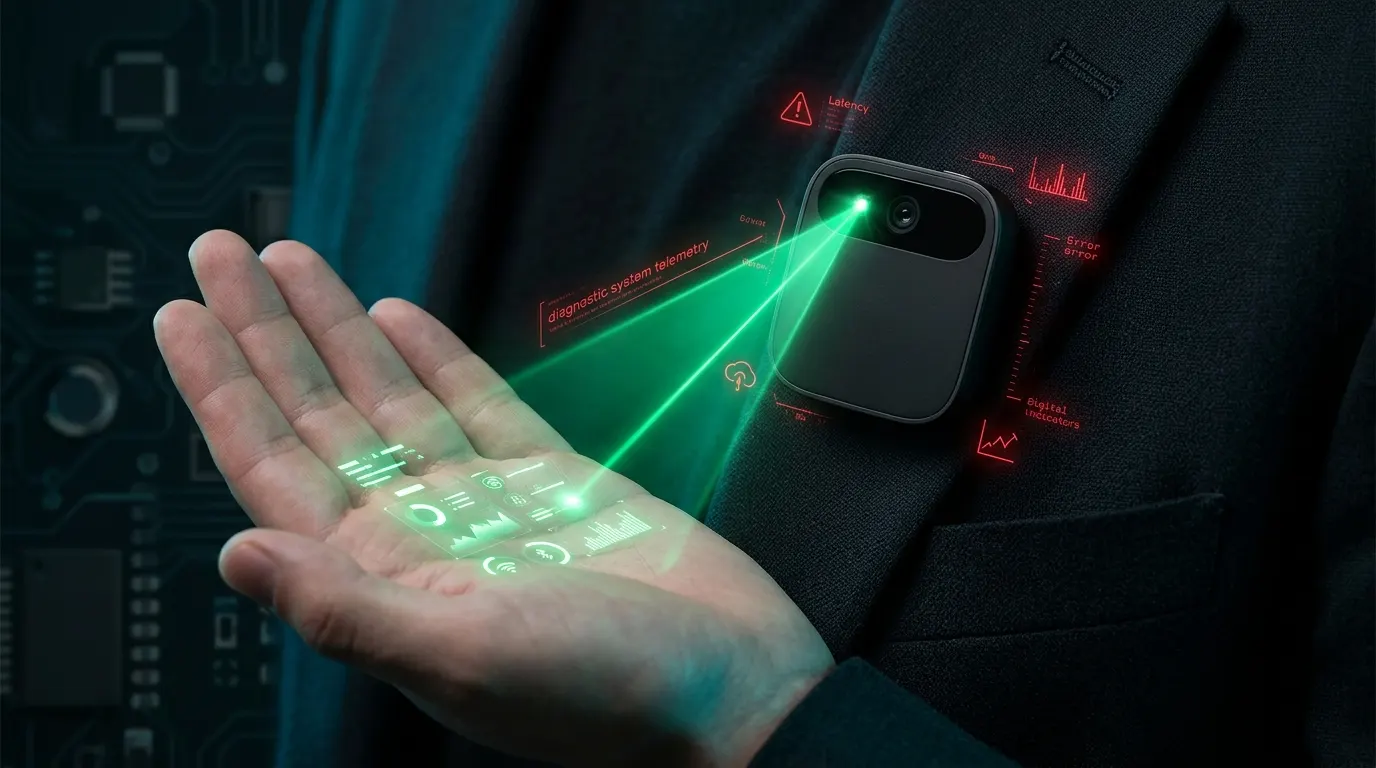
An in-depth technical post-mortem examining the thermal defects, cloud latency, optical limitations, and pricing errors that doomed the $230M Humane AI Pin.
Few consumer hardware launches in technology history arrived with more industry anticipation than the Humane AI Pin. Founded by former Apple design and engineering directors Imran Chaudhri and Bethany Bongiorno, Humane raised over $230 million in venture funding. Investors included prominent tech leaders such as Sam Altman, SoftBank, and Microsoft. The company boldly pitched the magnetic wearable as a smartphone killer. They promised an ambient artificial intelligence companion that would untether users from rectangular glass screens.
Instead, the product collapsed into one of the most visible tech disasters of the decade. Within months of its commercial debut in April 2024, devastating reviews and severe thermal throttling emerged. Staggering product return rates forced the company into survival mode. By early 2025, Humane halted sales and sold its intellectual property to HP. Furthermore, the company scheduled the permanent shutdown of its cloud servers, leaving thousands of $700 devices completely inoperable.
What caused such a well-funded product to disintegrate so rapidly? Below is the technical post-mortem and business analysis detailing the five fatal mistakes that doomed the Humane AI Pin.
The Five Fatal Flaws That Doomed the Humane AI Pin
1. Severe Thermal Overheating and Battery Throttling
The most immediate physical flaw reported by users was excessive heat. The Humane AI Pin housed a custom octa-core Qualcomm Snapdragon processor inside a compact, sealed aluminum enclosure. Laptops and smartphones utilize copper heat pipes, vapor chambers, or graphite spreaders. In contrast, the compact AI Pin had no internal room for passive heat dissipation.
According to comprehensive teardowns conducted by iFixit hardware analysis, the internal circuitry featured densely stacked logic boards with minimal airflow channels. The device pinned directly against clothing over the chest. Consequently, operating temperatures became a physical hazard. Running AI tasks, streaming music, or using cellular data pushed the unit into thermal throttling within fifteen minutes. The Pin regularly displayed blinking temperature warnings and shut down entirely to cool down.
Compounding this problem was battery life. The internal battery lasted barely two to three hours under moderate use. Humane tried to solve this with magnetic battery boosters. Users wore these boosters on the inside of clothing. However, the booster added noticeable weight and pulled down thin shirts. It also doubled heat transfer against the body.
2. Crippling Cloud Latency and AI Hallucinations
A personal digital assistant must deliver information faster than pulling a smartphone from your pocket. The Humane AI Pin failed this fundamental test. The device lacked local neural network acceleration. It could not process natural language models on-device.
Every single voice prompt, translation, or visual inquiry traveled through an active cellular connection to Humane cloud servers running CosmOS. The cloud servers then queried large language models before sending a response back to the device. As documented in early hands-on evaluations by The Verge review, this cloud loop introduced unbearable latency.
Users regularly waited between eight and fifteen seconds just to receive answers to simple queries. Worse, the underlying AI frequently hallucinated. It provided incorrect mathematical calculations and misidentified objects held in front of the camera. The software even failed to execute basic tasks like setting calendar reminders or alarms reliably.
3. Laser Ink Display: Optical Physics Failure in Direct Sunlight
To maintain a screenless form factor, Humane engineered a 720p monochrome green Laser Ink Display. A laser projector mounted on the top edge beamed text directly onto the user palm. It projected green icons and menus without glass. Users navigated the interface by tilting their wrist and pinching their fingers together.
While visually striking in controlled stage demonstrations, the laser projection failed against real-world optical physics. Ambient sunlight completely washed out the green laser projection. Outdoors, reading notifications required cupping your hand in shadow. Users had to step into shaded doorways to see text.
Holding your palm flat at chest height caused noticeable arm fatigue. Maintaining that position for more than a minute felt awkward. Using the laser projector proved vastly slower than checking a smartwatch. Glancing at an OLED smartphone screen was far more convenient.
4. The Prohibitive $699 Price Tag and $24/Month Subscription Wall
Consumer technology adoption requires a compelling ratio of price to performance. Humane priced the AI Pin as a luxury flagship device. The matte black Eclipse model launched at $699, while polished silver variants retailed for $799.
To make matters worse, the hardware was completely useless without a mandatory $24-per-month subscription. This recurring fee relied on T-Mobile network infrastructure. It covered cellular data, a dedicated telephone number, and cloud compute.
Consumers faced an upfront cost approaching $800 after taxes. They also had to pay nearly $300 in annual recurring fees. For that price, buyers expected a mature computing platform. Instead, they received a sluggish accessory. It could not even sync with their existing phone numbers or messaging accounts.
5. The Hardware Fire Recall and Massive Return Wave
The final blow to consumer confidence came from quality control and hardware safety failures. In June 2024, the United States Consumer Product Safety Commission and Humane issued an urgent safety recall. According to official alerts from the US Consumer Product Safety Commission (CPSC) recall, approximately 10,500 units of the Charge Case Accessory were affected.
An investigation revealed a serious battery cell defect. A third-party vendor supplied lithium cells prone to thermal runaway. These cells posed severe thermal runaway and fire risks. Users were advised to immediately stop using the charging case and unplug it from wall outlets.
Following this safety scare and universally negative reviews, consumer demand evaporated. Internal financial telemetry revealed a catastrophic milestone. By mid-summer 2024, a disastrous milestone arrived. Customer product returns outnumbered new sales on a daily basis. Fewer than 7,000 active devices remained in use globally. The platform bled millions of dollars in cloud maintenance costs.
Technical Specifications vs Real-World Performance Breakdown
The table below contrasts the technical promises made during Humane launch presentations against the measured reality documented during independent testing:
The Smartphone Displacement Fallacy
The broader conceptual failure of the Humane AI Pin lies in a fundamental misunderstanding of why smartphones dominate modern life. Humane founders operated on a flawed assumption. They believed consumers were desperate to eliminate smartphones entirely.
In reality, smartphones are visual computing hubs. They serve as multi-purpose digital workstations. Humans are visual creatures. We consume video, read long-form articles, review photographs, navigate high-density road maps, and authenticate financial transactions. None of these tasks work through voice commands alone. A low-resolution palm laser cannot handle dense visual workflows.
Smartphones combine high-resolution displays with fast local silicon. They pair rich application ecosystems with immediate tactile feedback in a pocketable design. Displacing this mature ecosystem required extraordinary utility. Launching a slower, less reliable, and more expensive wearable proved fatal.
The Aftermath: Server Shutdown and Bricked Hardware
Humane collapse accelerated rapidly throughout late 2024. Having depleted the vast majority of its $230 million venture funding, the company sought an outright acquisition. Discussions with potential tech buyers stalled quickly. Negative consumer reception and pending hardware liabilities derailed negotiations.
In early 2025, HP agreed to acquire Humane intellectual property, patents, and engineering staff. Crucially, the acquisition did not include sustaining the consumer hardware platform.
Humane announced that all cloud servers powering the AI Pin would shut down permanently on February 28, 2025. The Pin relied entirely on remote server routing. Consequently, the server shutdown turned every purchased unit into an unbootable paperweight.
The Humane AI Pin stands as a cautionary case study. Visionary concepts cannot compensate for thermal defects, unfinished software, and high recurring fees.
FAQs
What was the Humane AI Pin and how did it work?
The Humane AI Pin was a screenless, magnetic wearable gadget co-founded by former Apple executives Imran Chaudhri and Bethany Bongiorno. It clipped to clothing and used an internal camera, microphone, voice prompts, and a green Laser Ink Display projected onto the user hand to perform tasks without a traditional glass screen.
How much did the Humane AI Pin cost?
The device launched at a starting price of $699 for the matte black Eclipse edition, while polished silver variants cost $799. In addition to the hardware purchase, users had to pay a mandatory $24-per-month cellular subscription to keep the device connected and functional.
Can you still use the Humane AI Pin today?
No. Following the acquisition of Humane intellectual property by HP, all cloud servers powering the AI Pin were permanently taken offline on February 28, 2025. Because the device relied on cloud compute for all processing, remaining units are completely bricked and non-functional.
What were the primary reasons the Humane AI Pin failed?
The AI Pin failed due to severe hardware overheating, poor battery life lasting only two to three hours, slow response latency of up to fifteen seconds, unreadable laser projection in direct sunlight, and a mandatory monthly subscription fee. These flaws triggered a wave of product returns that outpaced new sales.
Did HP buy the Humane AI Pin?
HP acquired Humane patents, software assets, and select engineering personnel in early 2025. However, HP did not take over the consumer hardware business or continue supporting active devices, leading to the complete retirement of the product.
Key Takeaways
The story of the Humane AI Pin provides critical engineering and business lessons for the future of ambient artificial intelligence:
- Unviable Thermal Management: Packing an unthrottled Snapdragon processor into a sealed aluminum wearable without active cooling caused severe thermal shutdowns and skin discomfort.
- Cloud Bottlenecks Destroy Usability: Relying entirely on remote cloud servers rather than on-device neural processing introduced 8 to 15 second response delays that frustrated users.
- Unforgiving Pricing Strategy: Demanding $699 upfront plus a mandatory $24 monthly subscription for an unproven, single-purpose gadget alienates early adopters.
- Hardware Safety Failures: A formal US CPSC safety recall on 10,500 charging cases due to battery fire risks permanently crushed consumer brand trust.
- Screenless Computing Limits: Voice and palm projection cannot replace the rich visual, tactile, and app-driven ecosystem of modern smartphones.

Abdulrehman Khalid ✓ Verified Author
Founder & Lead Hardware Analyst at TechWorthies
Abdulrehman Khalid is a technology analyst, hardware researcher, and founder of TechWorthies. With extensive hands-on experience in benchmarking computer hardware, display interfaces, and wireless communications, he specializes in high-speed bus architectures, consumer electronics diagnostics, and emerging AI robotics. His technical guides prioritize empirical lab testing, official standards verification (IEEE, VESA, JEDEC), and actionable troubleshooting for hardware enthusiasts.