
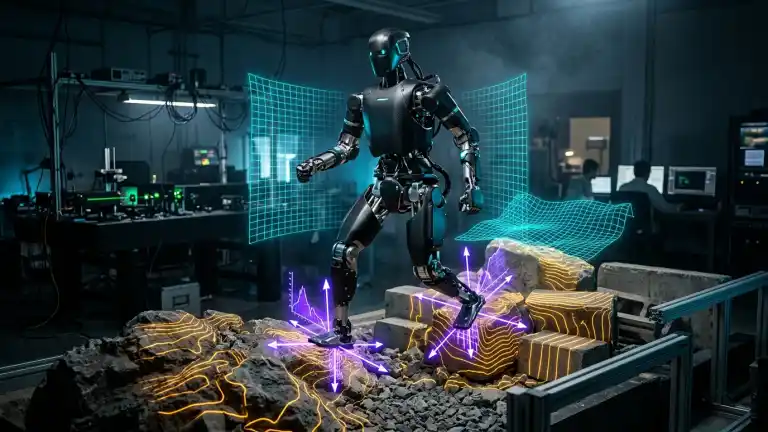
Discover how Physical AI and embodied intelligence are replacing classical machine learning. Explore world models, sensor fusion, and humanoid robots.
Artificial intelligence is moving beyond digital screens into the physical world. For years, computer vision systems focused mainly on passive image recognition. Researchers asked questions like How Do Robots Recognize Objects? to label static pictures. Today, autonomous machines and humanoid robots represent a massive paradigm shift. This shift is called Physical AI, or embodied intelligence. Classical software models only process text or image tokens in the cloud. In contrast, Physical AI models understand real-world physics, balance, and friction. By combining foundation models with sensors like LiDAR vs Camera in Robotics, Physical AI allows machines to interact safely with the real world.
What Is Physical AI (Embodied Intelligence)?
Physical AI refers to artificial intelligence embedded directly into mechanical bodies. These machines include humanoid robots, robotic arms, and autonomous delivery vehicles. These systems perceive, model, and actively manipulate their surroundings in real time. Classical industrial robots relied on rigid pre-programmed coordinates. In contrast, Physical AI uses closed-loop neural models that adjust continuously to changing forces.
Disembodied AI vs Physical AI
The difference between software intelligence and embodied intelligence comes down to physical feedback:
- Disembodied AI (Cloud LLMs): Works on text, code, or audio tokens. If a chatbot makes an error, the physical world does not change. The software faces no penalty for breaking physical laws.
- Physical AI (Embodied Systems): Must obey the laws of physics. A humanoid robot holding an object must calculate center-of-mass shifts in real time. It must measure surface friction on slippery floors. It must also balance motor forces to avoid dropping items or falling over.
The Core Pillars: How Physical AI Works
1. Multimodal World Models
World models sit at the center of Physical AI. Instead of guessing text words, a world model predicts physical outcomes. It processes data from cameras, depth sensors, and motor joints. Then, the model simulates what will happen next. It calculates how an object will slide, tip, or balance before taking action. This process allows robots to plan movements with foresight rather than blind trial and error.
2. End-to-End Sensorimotor Transformers
Historically, robotics required separate software modules. One engineer coded image recognition, while another built motion path planners. Physical AI replaces these separate steps with unified neural networks. The system maps raw camera frames directly to motor commands. This direct pipeline produces fluid, human-like agility and instant reflexes.
3. Simulation-to-Reality (Sim-to-Real) Training
Physical robots cannot practice through thousands of real-world crashes without damaging hardware. Instead, Physical AI models train inside physics simulators like Nvidia Isaac Sim. These tools simulate decades of practice in just a few parallel hours. By varying surface textures, weights, and sensor noise, the models transfer smoothly to physical robots.
Comparison: Classical Robotics vs Physical AI
| Capability Metric | Traditional Robotics | Early Deep Learning | Physical AI (Embodied) |
|---|---|---|---|
| Control System | Hardcoded Coordinates | Modular Machine Vision | Unified Sensorimotor Models |
| Physical Insight | None (Blind Movements) | Static 2D Bounding Boxes | Dynamic Physics World Models |
| Environment Fit | Factory Safety Cages | Controlled Lighting | Dynamic Real-World Spaces |
| Motion Planning | Fixed Kinematic Math | Scripted Motion Blocks | Real-Time Torque Generation |
| Sensor Setup | Limit Switches & Encoders | Basic RGB Camera | Full Sensor Fusion (LiDAR, Torque, Vision) |
| External Bumps | System Fault / Emergency Stop | Slow Hesitation or Freeze | Instant Reflex Balance Recovery |
| Task Flexibility | Single Repeated Action | Specific Trained Objects | Adapts to Brand-New Tasks |
Hidden Hardware Bottlenecks in Robotics
Online videos often show humanoid robots dancing or performing backflips. However, robotics engineers face three serious physical limits in everyday production:
1. The Tactile Sensing Gap
Human hands contain thousands of touch sensors that detect slippage, heat, and hardness. Today, most humanoid robots rely almost entirely on vision. Without durable artificial skin on robot fingers, machines struggle to handle delicate items like eggs or thin glass.
2. Motor Heat and Power Limits
Human muscles provide high power density and natural shock absorption. In contrast, electric motors inside robot joints produce intense heat during heavy lifting. Without active cooling or specialized gearboxes, robot joints risk overheating after 30 minutes of continuous work.
3. Battery Life vs Processing Power
Running a large Physical AI model requires substantial electrical power. A battery must power both the heavy electric motors and the fast onboard processors. Because of this high draw, most untethered humanoid robots can only run for two to three hours before recharging.
FAQs
How does Physical AI differ from ChatGPT?
ChatGPT works strictly in the digital domain to produce text, code, or images. Physical AI connects neural networks directly to physical motors. This connection allows the AI to understand real forces like friction and gravity to move physical objects.
Can Physical AI operate without an internet connection?
Yes. Safety reactions require millisecond timing to maintain balance or avoid obstacles. Therefore, Physical AI models run locally on onboard processors rather than waiting for cloud servers.
Which industries will adopt Physical AI first?
Warehouses, logistics depots, and factories will adopt Physical AI first. These sectors require repetitive heavy lifting, parcel sorting, and pallet moving in structured spaces before domestic home butlers become common.
Why are so many companies building humanoid robots?
Our entire world is built for the human body. Stairs, doors, vehicles, tools, and hallways are designed for human hands and feet. A humanoid shape lets robots use human spaces without expensive facility renovations.
Key Takings
- Embodied Frontier: Physical AI brings machine learning out of software screens and into physical machinery.
- Physics Foresight: World models forecast forces, momentum, and friction rather than simple text words.
- Direct Motor Control: Sensorimotor transformers replace fragile classical code with end-to-end reflex control.
- Simulator Training: High-speed physics simulators let robots practice decades of movement in hours.
- Hardware Barriers: Motor heating, battery capacity, and fingertip touch sensors remain the main hurdles in robotics.
Additional Resource
- Nature Machine Intelligence – Embodied AI and Robotics: Scientific research papers tracking sensorimotor policies, bio-inspired actuators, and world model physics integration.

Abdulrehman Khalid ✓ Verified Author
Founder & Lead Hardware Analyst at TechWorthies
Abdulrehman Khalid is a technology analyst, hardware researcher, and founder of TechWorthies. With extensive hands-on experience in benchmarking computer hardware, display interfaces, and wireless communications, he specializes in high-speed bus architectures, consumer electronics diagnostics, and emerging AI robotics. His technical guides prioritize empirical lab testing, official standards verification (IEEE, VESA, JEDEC), and actionable troubleshooting for hardware enthusiasts.