
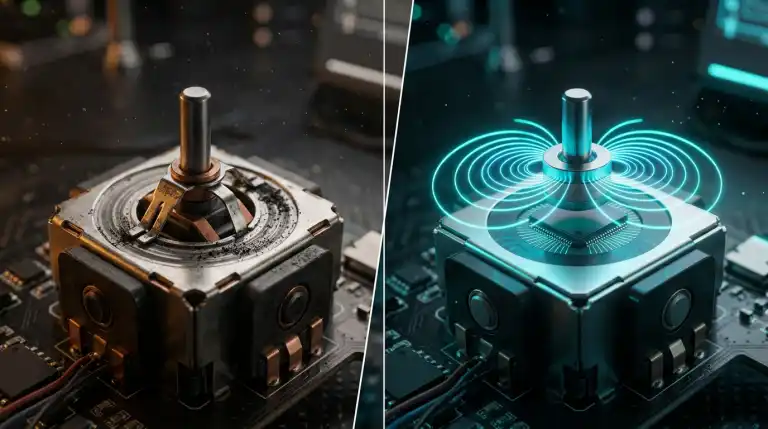
Compare Hall Effect vs potentiometer joysticks in gamepads. Learn how magnetic sensors eliminate stick drift, improve circularity, and extend gamepad lifespan.
For decades, console gamers accepted analog stick drift as an unavoidable reality of modern gaming. You buy an expensive controller and enjoy great precision for months. Then you watch helplessly as characters drift into walls or crosshairs wander off target. Controller manufacturers routinely blamed dust, aggressive thumb pressure, and normal wear and tear. Yet the problem was never the gamer. The flaw was an outdated sensor design that relied on physical friction. Traditional joysticks rely on physical friction to track movement. This mechanical design leads to premature failure. Today, a hardware revolution is transforming the peripheral industry: Hall Effect magnetic sensing technology.
Test Your Joystick Circularity and Centering Error:
Measure your controller stick circularity error, deadzone deviation, and raw coordinate telemetry right now using our free Gamepad and Controller Stick Drift Tester.
Hall Effect joysticks promise what once seemed impossible: permanent immunity to analog stick drift. Third-party controller brands like 8BitDo, GameSir, Flydigi, and PB Tails have aggressively adopted magnetic sensors, while first-party giants like Sony and Microsoft still largely equip their standard controllers with traditional potentiometers. But how exactly do magnetic sensors work? Do they genuinely outperform traditional joysticks in competitive accuracy, circularity error, and responsiveness? In this comprehensive technical guide, we compare Hall Effect and potentiometer joysticks across physics, durability, power consumption, and competitive gaming precision.
How Traditional Potentiometer Joysticks Work
To understand why Hall Effect sensors represent such a massive leap forward, you must first inspect the mechanical limitations of traditional potentiometers. Standard joysticks from ALPS Alpine have powered home consoles for decades. They have remained largely unchanged since the early PlayStation era.
Two potentiometers measure movement inside a standard joystick module. One tracks the horizontal X-axis while the other measures the vertical Y-axis. Each potentiometer contains a curved circular track. It is coated with a thin layer of conductive carbon film. A three-pronged metal wiper rests on the track. It is stamped from flexible phosphor bronze.
Pushing the thumbstick rotates an internal pivot. This forces the metal wiper to scrape across the carbon track continuously. This movement changes circuit resistance. The controller measures fluctuating voltage and translates it into coordinates. The console reads these coordinates. It determines exactly how far and in what direction the stick tilted.
The fatal flaw of this design is continuous mechanical friction. Every time you move your thumbstick, metal scrapes against carbon. Over months of play, the metal wiper acts like sandpaper. It grinds the carbon film into loose black dust. This friction carves permanent gouges and dead spots into the resistive surface. Electrical contact becomes erratic over time. It sends false voltage spikes to the console even when the stick sits untouched. To learn how to clean or calibrate failing potentiometers, read our practical troubleshooting guide on How to Fix Controller Stick Drift Fast.
The Physics of Hall Effect Sensors: Contactless Magnetism
Hall Effect joysticks replace scraping metal contacts with contactless electromagnetic physics. The technology is named after American physicist Edwin Hall, who discovered the principle in 1879.
The Hall Effect occurs in conductive plates inside magnetic fields. Electrical current flows through a thin conductor perpendicular to the magnetic field. When the magnetic field is undisturbed, electrons flow in a straight line through the conductor. Magnetic fields push moving electrons toward one side of the plate. This physical Lorentz force alters the path of electrical charges. This electron buildup creates a measurable voltage. Physicists refer to this signal as the Hall voltage.
Hall Effect Electromagnetic Operation:
[ Permanent Neodymium Magnet ] (Attached to moving thumbstick shaft)
            |
       (Magnetic Flux Field Moves in 3D Space)
            |
[ Solid-State Hall Sensor IC ] (Mounted statically on circuit board)
            |
(Generates variable Hall voltage proportional to magnetic field angle)
(ZERO physical contact. ZERO friction. ZERO mechanical wear.)
A tiny neodymium magnet mounts to the base of the thumbstick shaft. It moves freely with your thumb inputs. A solid-state Hall sensor chip solders directly beneath the magnet. It remains static on the circuit board. When the thumbstick sits centered, the magnetic field rests symmetrically above the sensor. Tilting the stick shifts the physical position of the magnet. This alters the angle of the magnetic field passing through the sensor chip.
The sensor detects magnetic flux changes. It generates an exact electrical voltage proportional to the tilt angle. Crucially, the magnet and sensor chip never touch. They interact through invisible magnetic field lines across an open air gap. Magnetic field lines bridge the gap effortlessly. There is no metal wiper scraping carbon film. This results in zero friction, zero abrasion, and zero mechanical wear.
Why Hall Effect Joysticks Never Drift.
The durability difference between potentiometer and Hall Effect mechanisms is monumental. While traditional ALPS potentiometers are rated for roughly two million rotational cycles before degradation sets in, Hall Effect sensors are rated for tens of millions of cycles.
Only the gimbal and return spring experience friction in Hall Effect sticks. These components center the shaft when released. Even after five or ten years of daily competitive use, the electromagnetic sensing elements remain as pristine as the day they left the factory. There is no carbon track to grind away. There is no metal wiper to lose mechanical tension. A Hall Effect controller will retain its factory centering accuracy indefinitely.
| Comparison Factor. | Traditional Potentiometer. | Hall Effect Magnetic Sensor. |
|---|---|---|
| Sensing Mechanism. | Metal wiper scraping carbon film. | Permanent neodymium magnet & IC. |
| Friction Contact. | Continuous mechanical friction. | Completely contactless (Air gap). |
| Stick Drift Vulnerability. | High (Occurs in 4 to 12 months). | Immune (Zero sensor wear over life). |
| Rotational Lifespan. | Approx 2 Million cycles. | 5 Million to 30 Million cycles. |
| Circularity Error. | Typically 8% to 18% (Cardioid/Square). | Ultra-low 0.5% to 5% (True Circle). |
| Power Consumption. | Extremely low passive resistance. | Requires active sensor IC power. |
Circularity Error and Precision: The Competitive Advantage
Beyond longevity, Hall Effect joysticks offer dramatic advantages in competitive aiming precision, deadzone customization, and circularity tracking.
Circularity error measures geometric tracking accuracy. It tests how closely stick rotation matches a perfect circle. Traditional potentiometer controllers often suffer from high circularity error, typically ranging between 8% and 18%. Potentiometers measure axes independently using flat resistors. This causes square deadzone distortion where diagonal inputs accelerate unnaturally.
High-end Hall Effect controllers use advanced microcontrollers. They calculate 3D magnetic vector math in real time. Circularity error on Hall Effect sticks measures below 1%. This provides a mathematically perfect circular boundary for aiming. Uniform circularity eliminates diagonal acceleration spikes. In games like Apex Legends and Warzone, crosshairs glide with predictable smoothness.
Furthermore, because Hall Effect sensors do not suffer from carbon degradation, gamers can set their in-game inner deadzones to absolute zero. On potentiometers, setting deadzones to zero triggers camera drift. Worn carbon tracks make pure zero deadzones impossible. On Hall Effect sticks, a true 0% deadzone delivers instant micro-aiming. You gain precision sniper control without unwanted drift.
Power Draw and Magnetic Shielding Challenges
If Hall Effect technology is superior in every way, why have Sony and Microsoft been slow to adopt it in standard console controllers? Beyond corporate cost margins, Hall Effect joysticks introduce distinct electrical engineering challenges in wireless battery life and electromagnetic interference.
A traditional potentiometer is a passive resistive component that draws virtually zero standby current. A Hall Effect sensor is an active integrated circuit. It constantly consumes power to energize its semiconductor array. Powering four active Hall sensors reduces wireless battery runtime by 10% to 20%. Manufacturers balance this by optimizing sleep states.
The second engineering challenge is electromagnetic interference. Hall Effect sensors are exceptionally sensitive magnetic detectors. In modern controllers featuring powerful rumble vibration motors, high-torque haptic voice-coil actuators, and wireless radio transmitters, stray magnetic fields can interfere with stick tracking. Manufacturers install mu-metal shielding plates around joystick modules. This shields the magnetic sensors from vibration motor fields. For wireless controllers, stable radio transmission is equally important; you can read about signal interference in our analysis of Why Bluetooth Audio Cuts Out When Walking.
TMR Joysticks: The Next Frontier Beyond Hall Effect
While Hall Effect sensors dominate current high-end gaming controllers, peripheral engineers are already deploying an even more advanced magnetic architecture: Tunnel Magnetoresistance (TMR) sensors.
TMR technology uses quantum mechanical electron tunneling. Electrons tunnel across ultra-thin insulating barriers between magnetic layers. Hall sensors measure transverse voltage from magnetic fields. TMR sensors change internal resistance based on magnetic alignment. TMR joysticks consume a fraction of the electrical power. They provide higher signal-to-noise ratios and ultra-dense 12-bit coordinate resolution.
Controllers featuring TMR sensors from brands like PB Tails and Gulikit offer the absolute pinnacle of stick durability and micro-aim responsiveness, proving that magnetic sensing is the undisputed future of gaming peripherals.
Step-by-Step Testing: How to Verify Your Controller Joysticks
Whether your gamepad uses traditional potentiometers or modern Hall Effect sensors, you can benchmark its tracking fidelity in thirty seconds.
- Connect your controller to your PC using a USB cable or Bluetooth wireless connection.
- Launch the Gamepad and Controller Stick Drift Tester in your web browser.
- Press any face button to establish the HTML5 Gamepad API connection.
- Release your hands from the controller and inspect the center coordinates. If the stick centers at (0.00, 0.00) or within 0.02, your hardware possesses excellent centering tension.
- Slowly rotate your thumbstick in three complete circular revolutions along the outer plastic collar.
- Observe the real-time circularity error score. A score below 3% confirms exceptional magnetic tracking, while a score above 12% indicates traditional potentiometer distortion.
FAQs
Can you install Hall Effect joysticks into an existing PS5 DualSense or Xbox controller?
Yes. Enthusiasts with basic soldering skills can purchase aftermarket Hall Effect modules (such as Gulikit or Junsen magnetic sticks) and solder them directly into DualSense, DualShock 4, or Xbox controller motherboards. Because Hall sensors require precise magnetic centering, you must calibrate the modules using open-source hardware calibration web tools after installation.
Do Hall Effect joysticks feel different to play with?
In terms of physical thumb feel, Hall Effect sticks feel virtually identical to high-quality potentiometers because tactile resistance is determined by the mechanical centering spring rather than the sensors. However, in gameplay, Hall Effect sticks feel noticeably smoother because there is zero friction drag from internal metal wipers.
Why do some Hall Effect controllers still feel jumpy?
If an inexpensive Hall Effect controller lacks proper magnetic shielding, electrical noise from internal rumble motors can corrupt sensor readings. Quality Hall Effect controllers use calibrated magnetic algorithms and mu-metal shields to deliver jitter-free telemetry.
Do Hall Effect analog triggers also prevent trigger failure?
Yes. Many modern controllers utilize Hall Effect magnetic sensors in both the thumbsticks and the analog L2/R2 triggers. Magnetic triggers eliminate sliding potentiometer contacts, preventing trigger sticking, spring friction, and deadzone corruption.
Key Takeaways:
- Traditional potentiometer joysticks rely on metal wipers scraping carbon film tracks, causing friction wear, carbon erosion, and inevitable stick drift.
- Hall Effect joysticks utilize permanent neodymium magnets and solid-state semiconductor sensors to detect movement across an air gap with zero physical contact.
- Because Hall Effect components experience zero friction wear, they are physically immune to stick drift and retain factory centering accuracy for millions of cycles.
- Magnetic controllers deliver superior circularity error (often below 1%) and allow gamers to play with pure 0% in-game deadzones without camera jitter.
- Active magnetic sensors consume slightly more battery power than passive potentiometers and require electromagnetic shielding to prevent interference from rumble motors.
- You can test your stick circularity error, centering stability, and axis telemetry in real time using our interactive browser gamepad tester.

Abdulrehman Khalid ✓ Verified Author
Founder & Lead Hardware Analyst at TechWorthies
Abdulrehman Khalid is a technology analyst, hardware researcher, and founder of TechWorthies. With extensive hands-on experience in benchmarking computer hardware, display interfaces, and wireless communications, he specializes in high-speed bus architectures, consumer electronics diagnostics, and emerging AI robotics. His technical guides prioritize empirical lab testing, official standards verification (IEEE, VESA, JEDEC), and actionable troubleshooting for hardware enthusiasts.