
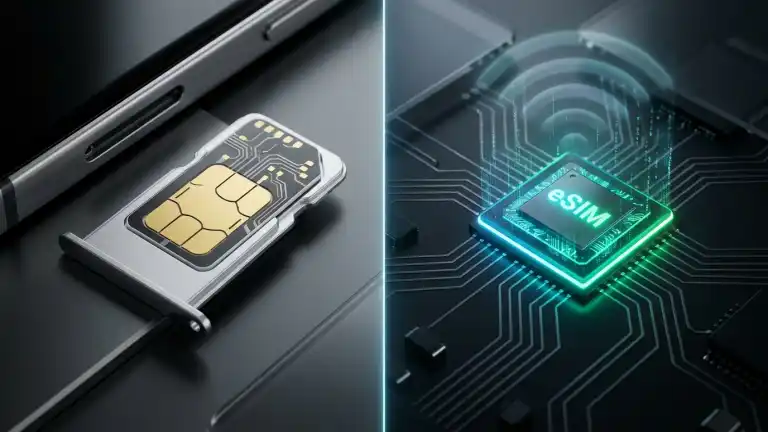
Compare eSIM vs Physical SIM in-depth. Discover key differences in digital profile switching, dual-SIM travel roaming, theft security, and phone compatibility.
The mobile telecommunications landscape is undergoing a massive hardware transition as embedded SIM (eSIM) technology increasingly replaces the traditional, removable physical SIM card. Just as contactless short-range wireless protocols have transformed modern payments and digital passes through NFC Card Emulation vs Reader Mode, eSIM chips digitize cellular subscriber authentication directly on smartphone motherboards. With flagship manufacturers like Apple, Google, and Samsung steadily phasing out physical SIM trays in favor of all-digital connectivity, understanding the differences between physical SIM cards and eSIMs is essential for seamless international travel, carrier switching, and mobile security.
What Is a Physical SIM Card?
A Subscriber Identity Module (SIM) card is a removable integrated circuit chip housed inside a tiny plastic casing. Introduced in 1991, physical SIM cards have progressively shrunk over the decades from full credit-card-sized chips down to mini-SIM, micro-SIM, and today’s standard nano-SIM (measuring just 12.3 mm × 8.8 mm).
The physical card contains an embedded microcontroller that securely stores your International Mobile Subscriber Identity (IMSI) number, 128-bit authentication keys (Ki), and network operator credentials required to securely connect to cellular towers.
What Is an eSIM (Embedded SIM)?
Ratified by the GSMA and technically designated as an eUICC (Embedded Universal Integrated Circuit Card), an eSIM is a microscopic silicon semiconductor (measuring just 6 mm × 5 mm) permanently soldered directly onto a device’s logic board during manufacturing.
Unlike physical SIMs that are permanently burned with a single carrier’s cryptographic credentials at the factory, an eSIM can be programmed, updated, and reconfigured over-the-air (OTA) via secure digital certificates, allowing users to download or delete mobile network profiles remotely in seconds.
Key Differences: eSIM vs Physical SIM
1. Installation and Carrier Activation
The initial setup process reveals the most immediate difference between the two technologies:
- Physical SIM: Requires waiting for a plastic card to arrive by mail or visiting a retail carrier store, followed by locating a specialized SIM ejector tool (or paperclip) to physically open a spring-loaded mechanical tray.
- eSIM: Activates digitally within minutes. You simply purchase a plan online, scan a provided QR code with your phone camera, or verify the profile directly inside your carrier’s mobile application.
2. Multiple Carrier Profiles and Dual-SIM Flexibility
Managing multiple phone numbers or network subscriptions differs dramatically:
- Physical SIM: Storing more than one number requires a phone featuring a dual physical SIM slot (rare in North American models) or manually swapping delicate plastic chips back and forth.
- eSIM: Can digitally store 5 to 10 distinct carrier profiles simultaneously on the internal chip memory. While only one or two profiles can remain actively connected to mobile data at any given millisecond (Dual SIM Dual Standby), you can toggle between your personal number, work line, and travel roaming package through device settings without touching hardware.
3. Device Swapping in an Emergency
Physical SIM cards retain a distinct tactical advantage during hardware emergencies. If your smartphone suffers a shattered screen, water damage, or a dead battery, you can simply pop out the physical nano-SIM card and slide it into a backup phone in 10 seconds flat. Moving an active eSIM profile requires access to the original phone’s screen or logging into your carrier portal with two-factor authentication (which may itself require receiving an SMS code).
4. International Travel and Roaming Convenience
For international globetrotters, eSIM represents a massive revolution:
- Physical SIM: Travelers traditionally face long airport kiosk lines in foreign countries, passport photocopying, currency exchanges, and the risk of misplacing their tiny primary home SIM card while traveling.
- eSIM: Allows travelers to purchase affordable regional data packages (via global providers like Airalo or Holafly) days before departure. The foreign data profile activates automatically the second your airplane lands, leaving your primary home number active for important bank OTPs.
5. Theft Security and Tracking Durability
eSIM provides superior anti-theft defense for mobile devices:
- Physical SIM: When a phone is stolen, thieves immediately eject the plastic SIM card to sever the cellular connection, preventing Apple’s Find My or Google’s Find My Device from pinpointing real-time GPS coordinates.
- eSIM: Cannot be physically removed from the phone. Even if the thief powers the device off and on, the embedded cellular connection remains active and tied to your tracking credentials as long as the phone has power.
6. Hardware Design and Water Resistance
Eliminating the physical SIM tray frees up valuable internal volume inside ultra-slim smartphones, smartwatches, and tablets. Removing the tray aperture also eliminates a primary entry point for water and dust ingress, allowing manufacturers to achieve superior IP68 weather sealing and dedicate extra board space for larger battery cells.
Technical Comparison Table
| Feature / Specification | Physical SIM (Nano-SIM) | eSIM (eUICC Chip) |
|---|---|---|
| Physical Form | Removable plastic card (12.3 x 8.8 mm) | Soldered silicon chip (6 x 5 mm) |
| Activation Method | Manual insertion via tray & pin | Digital QR code or carrier app |
| Stored Profiles | 1 network profile per card | 5 to 10 profiles stored internally |
| Simultaneous Active Lines | 1 (or 2 with dual-tray models) | Up to 2 active lines concurrently |
| Emergency Device Swap | Instant (10 seconds, no internet needed) | Requires carrier app or portal transfer |
| Travel Convenience | Must buy local plastic card at kiosk | Pre-installed digital data packages |
| Anti-Theft Security | Easily ejected by thieves to stop tracking | Cannot be removed; tracking persists |
| Water & Dust Ingress | Tray cutout is potential leak point | Zero cutouts; superior IP68 sealing |
| Device Compatibility | Universal (All mobile phones) | Requires modern eSIM-compatible phone |
| Cost to Replace | Carrier replacement fee ($5–$15) | Usually free digital re-download |
What Other Guides Miss: Critical Telecom Nuances
1. Carrier Lock and Transfer Friction
If your phone is carrier-locked (purchased on an installment plan from AT&T, Verizon, or T-Mobile), the device’s eSIM firmware is locked down just like a physical slot. You cannot activate a secondary international travel eSIM on an installment-locked phone until the device is paid off and unlocked by your primary carrier.
2. SM-DP+ and SM-DS Architecture
Behind every eSIM activation lies GSMA’s Subscription Manager Data Preparation (SM-DP+) server architecture. When you scan a QR code, your phone establishes an encrypted TLS session with the carrier’s SM-DP+ server to securely download a cryptographic container called a Local Profile Assistant (LPA). Without active Wi-Fi during initial setup, an unprovisioned phone cannot reach the server to download its first profile.
3. The Emerging iSIM Standard (Integrated SIM)
While consumers are currently adapting to eSIM, the industry is already testing iSIM (Integrated SIM). Supported by Qualcomm Snapdragon 8 Gen series chipsets, iSIM integrates subscriber authentication circuitry directly into the main mobile Application Processor (APU), eliminating even the dedicated eSIM silicon chip to maximize battery efficiency.
Which One Is Right for You?
Stick with Physical SIM If:
- You switch handsets frequently between work and personal backup phones.
- You live in or travel to developing regions where local prepaid mobile operators do not support eSIM QR provisioning.
- You prefer total tactile control over your carrier hardware without dependency on carrier cloud accounts.
Embrace eSIM If:
- You travel internationally and want instant, affordable mobile data the moment you touch down.
- You want maximum theft deterrence so thieves cannot disconnect your phone from GPS tracking.
- You juggle multiple phone numbers (personal, business, freelance) on a single compact smartphone.
- You own a US-market iPhone (iPhone 14, 15, or 16 series) where physical SIM trays have been completely eliminated.
Frequently Asked Questions (FAQs)
Does an eSIM have worse signal or slower internet speeds than a physical SIM?
No. Both eSIMs and physical SIM cards function strictly as secure authentication tokens to verify your account with the cellular tower. Once authenticated, 5G and 4G LTE download speeds, call clarity, and signal coverage depend entirely on your phone’s internal antennas and local carrier tower infrastructure.
Can an eSIM be hacked remotely?
eSIM architecture uses banking-grade hardware encryption (EAL4+ certified secure elements) and authenticated GSMA cryptographic certificates. It is actually significantly more secure than physical SIM cards, which are vulnerable to physical cloning and manual theft.
Can I convert my physical SIM into an eSIM?
Yes. Most modern carriers (including Verizon, AT&T, T-Mobile, Vodafone, and EE) allow users to convert a physical SIM into an eSIM directly through smartphone operating system settings (iOS “Convert to eSIM” feature) or via the carrier’s customer web portal.
What happens to my eSIM if I factory reset my phone?
When performing a factory reset on an iOS or Android device, the operating system explicitly asks whether you wish to keep or delete your downloaded cellular plans. Selecting “Keep eSIM Plans” wipes your personal files and apps while leaving your active mobile carrier profile intact.
Key Takings
- Hardware Evolution: eSIM replaces physical plastic nano-SIM cards with a permanently soldered 6×5 mm microchip.
- Multi-Profile Flexibility: eSIMs store 5 to 10 carrier profiles digitally, enabling seamless switching between home lines and travel roaming.
- Superior Anti-Theft Protection: Thieves cannot eject an eSIM to sever cellular tracking networks like Find My.
- Instant Remote Activation: New lines activate in minutes via digital QR codes without waiting for postal delivery or store visits.
- Emergency Swap Trade-off: Physical SIMs still offer faster 10-second manual swaps to backup phones if a screen shatters.
Additional Resource
• GSMA Official eSIM Technical Specifications: The global telecommunications industry standard guidelines detailing Remote SIM Provisioning architecture, security compliance, and consumer device implementation.

Abdulrehman Khalid ✓ Verified Author
Founder & Lead Hardware Analyst at TechWorthies
Abdulrehman Khalid is a technology analyst, hardware researcher, and founder of TechWorthies. With extensive hands-on experience in benchmarking computer hardware, display interfaces, and wireless communications, he specializes in high-speed bus architectures, consumer electronics diagnostics, and emerging AI robotics. His technical guides prioritize empirical lab testing, official standards verification (IEEE, VESA, JEDEC), and actionable troubleshooting for hardware enthusiasts.