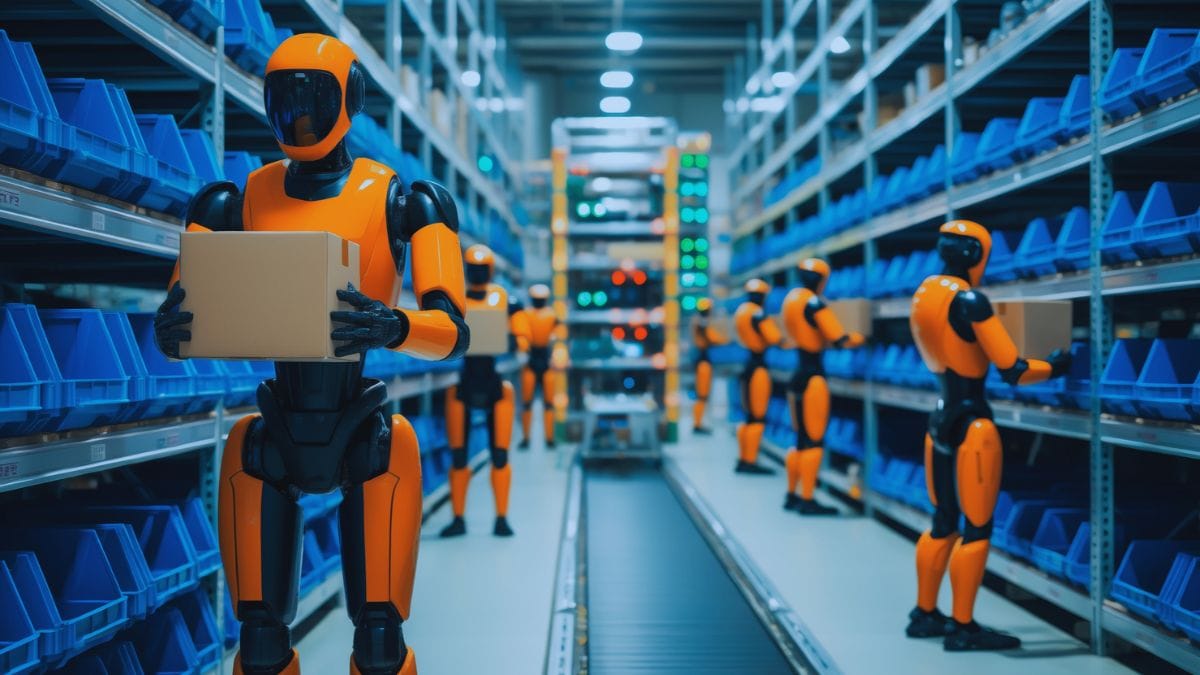
Explore the kepler robot K2 Bumblebee, including its specs, price, AI technology, capabilities, battery life, payload, and industrial uses.
The Kepler robot is a full-size humanoid robot designed by Kepler Robotics for industrial and commercial applications. Its best-known model, the K2 Bumblebee, combines a human-like body with advanced robotic systems for movement, sensing, and object handling. The robot is built to support tasks in manufacturing, logistics, inspection, research, and other work environments where automation can improve efficiency.
Unlike traditional fixed industrial machines, the K2 is designed as a mobile humanoid robot that can walk, interact with objects, and perform different tasks. It uses embodied AI, multiple sensors, and a hybrid actuator system to control its movements and respond to its surroundings, similar to the broader trend toward screenless AI gadgets that use AI to interact with users without relying on traditional screens. With its 52 degrees of freedom and reported 30 kg payload, the Kepler K2 is aimed at bringing flexible robotics into real-world industrial settings.
What Is the Kepler Robot?
The Kepler robot is a humanoid robotics platform developed by Shanghai Kepler Robotics. Its current flagship model is the Forerunner K2“ Bumblebee.” Kepler introduced the K2 at GITEX GLOBAL in October 2024. The company described it as a full- sized, general- purpose humanoid intended to eventually work across real- world industrial scenarios. Its development was informed by discussions with nearly 50 potential customers and testing in areas such as manufacturing, warehousing, logistics, high- risk operations, research, and education.
The K2 was later demonstrated at ICRA 2025, where Kepler showed autonomous mobility and interaction capabilities. The company subsequently announced further demonstrations, software upgrades, and mass production.
Kepler K2 Bumblebee at a Glance
| Specification | Kepler K2 |
| Height | 175 cm |
| Weight | 75 kg |
| Degrees of freedom | 52 |
| Onboard computing | 100 TOPS |
| Sensors | More than 80 |
| Dual- arm payload | Up to 30 kg claimed |
| Payload per arm | Up to 15 kg claimed |
| Operating time | Up to 8 hours claimed |
| Charging time | About 1 hour for the stated endurance claim |
| Hands | 11 DoF each |
| Primary focus | Industrial applications |
These figures come primarily from Kepler’s product and company announcements and should be treated as published manufacturer specifications or claims, rather than independent laboratory measurements.
Kepler K2 Specifications
The K2 is designed around a human- sized form factor while incorporating hardware intended for industrial workloads.
Height, Weight, Degrees of Freedom, and Computing Power
The K2 stands 175 cm tall and weighs approximately 75 kg. Its full- body system has 52 degrees of freedom( DoF), allowing coordinated movement across its body and manipulators. Kepler also reports more than 80 integrated sensors.
The robot has an onboard computing capability of up to 100 TOPS. TOPS, or trillion operations per second, is a common way of describing AI inference hardware performance.
The number alone does not determine how capable a robot is. Real- world performance also depends on the models being used, sensors, control software, latency, power consumption, and how effectively those systems work together.
Payload, Battery Life, Sensors, and Dexterous Hands
Kepler reports a 15 kg payload per arm and up to 30 kg using both arms. The company also states that the K2 can operate for up to eight hours after a one- hour charge. ( The K2’s hands are another important part of its design. Kepler says each hand has 11 degrees of freedom, while the company’s earlier K2 announcement described force- sensing contact points and a six- axis force/ torque sensor at the wrist.
These systems are intended to give the robot more control when handling objects rather than simply moving an arm from one position to another.
How Does the Kepler K2 Robot Work?
One of the K2’s defining characteristics is its hybrid actuation architecture.
Instead of relying exclusively on conventional rotary actuators, Kepler combines planetary roller- screw linear actuators with rotary actuators.
Hybrid Roller- Screw and Rotary Actuator System
A planetary roller screw is a mechanical transmission that converts rotary motor motion into linear movement.
In a humanoid robot, this type of mechanism can be used to generate high force and precise movement at joints.
Kepler says its hybrid serial- parallel architecture combines these linear and rotary systems to provide the force, precision, and control needed for industrial movements. The company reports energy efficiency of up to 81.3% for the architecture.
The design also supports the K2’s straight- knee walking approach.
For readers who are not familiar with robotics, the basic concept can be simplified as:
Electric motor→ transmission→ joint movement→ controlled body motion
The difficult part is coordinating dozens of motors and sensors simultaneously while keeping a dynamically balancing robot stable.
Walking, Balance, and Motion Control
Bipedal walking is significantly more complicated than driving a wheeled robot across a flat floor.
The K2 uses a straight- knee bipedal gait, according to Kepler. The company has also demonstrated obstacle navigation and walking across different surfaces.
Kepler says it uses reinforcement learning and imitation learning to train locomotion and reduce the gap between simulated behavior and real- world movement. This is commonly known as the sim- to- real problem in robotics.
The challenge is that a simulation can never perfectly reproduce real- world friction, sensor noise, delays, mechanical tolerances, unexpected contact, or changing terrain.
Vision, Tactile Sensing, and Interaction
The K2 combines multiple sensing systems rather than relying on vision alone.
Its reported sensor package includes more than 80 integrated sensors, while the hands incorporate force and tactile sensing intended to improve manipulation.
This matters because industrial tasks often require the robot to understand not only where an object is, but also whether it has successfully grasped it and how much force is being applied.
Kepler K2 AI and Embodied Intelligence
The K2’s hardware is only one part of the platform.
Kepler has also described an embodied intelligence system that combines perception, planning, learning, and motion control.
VLA+ and Task Execution
Kepler has referred to a layered VLA+ model for processing semantic commands and executing tasks. VLA generally refers to vision- language- action systems, which connect visual information and language instructions with physical actions.
In practical terms, the goal is to move from:
“ Detect this object.”
to something closer to:
“ Pick up these components and place them in the appropriate location.”
The robot then needs to perceive its surroundings, understand the task, plan actions, control its body, and verify the result.
Kepler has reported demonstrations involving tasks such as sorting, assembly, and guided interactions. These are company- reported capabilities rather than a guarantee that every task can be performed autonomously in arbitrary environments.
Reinforcement Learning, Imitation Learning, and Sim- to- Real Training
Kepler says it uses both reinforcement learning and imitation learning in the K2’s development.
Reinforcement learning allows a robot controller to improve through feedback from actions and outcomes. Imitation learning, meanwhile, allows systems to learn behaviors from demonstrations.
For humanoid robots, these techniques can be used for:
- Walking
- Balance recovery
- Manipulation
- Motion coordination
- Obstacle navigation
- Task execution
Kepler has specifically discussed using these approaches to address the difference between simulated environments and physical robots.
What Can the Kepler Robot Do?
The K2 is primarily designed for industrial and structured environments, rather than being marketed simply as a household robot like emerging AI Home Robots.
Kepler has identified several potential application areas.
Manufacturing and Factory Tasks
Manufacturing is one of the company’s main targets.
Potential tasks include:
- Material handling
- Component movement
- Assembly- related work
- Inspection
- Repetitive operations
- Quality- control activities
Kepler has reported testing the K2 in customer environments for tasks including material handling, sample processing, stamping- material collection, and quality inspection.
Logistics, Material Handling, and Inspection
Humanoid robots are attractive for certain logistics applications because they can theoretically interact with environments already designed for population.
A human- shaped machine can potentially:
- Transfer objects
- Pick up components
- Navigate workspaces
- Move between stations
- Perform inspection tasks
- Handle repetitive material- transfer work
Kepler has specifically identified warehousing and logistics as target markets for K2.
Research, Demonstrations, and Specialized Operations
K2 is also intended for research and education, demonstrations, and specialized applications.
The company has described use cases involving high- risk operations and specialized industrial environments.
That does not mean the robot is already performing every one of these tasks at large commercial scale. It is important to distinguish target applications, demonstrations, customer trials, and established deployments.
Kepler Robot Price and Availability
Price is one of the most searched aspects of the Kepler robot.
In its June 2025 ICRA announcement, Kepler reported a$ 30, 000 base- model price for the K2.
Later, in September 2025, Kepler announced mass production and reported a price of RMB 248, 000 per unit. The same announcement said K2 units had begun shipping to customers.
Because these figures were announced at different times and may relate to different commercial configurations or pricing conditions, they should not automatically be treated as a single current US retail price.
Mass Production and Customer Shipments
Kepler announced the start of mass production in September 2025 and said that K2 units had begun shipping to customers. The company also reported framework agreements covering several thousand units.
That represents a significant change from the prototype stage.
However, commercial availability should not be confused with widespread deployment. Independent analysis of the humanoid- robot industry continues to point out that scaling reliable humanoid robots across large numbers of real- world workplaces remains difficult. Battery life, reliability, safety, demand, and deployment economics are all major considerations.
Kepler Robot Development Timeline
The K2 has gone through several stages of development.
2024: Forerunner K2 Launch
Kepler officially introduced the Forerunner K2 at GITEX GLOBAL 2024.
At launch, the company described improvements in embodied intelligence, perception, navigation, motion control, manipulation, and customer- oriented industrial applications.
2025: ICRA Demonstration
At ICRA 2025, Kepler demonstrated the K2 publicly and highlighted its industrial design, autonomous mobility, sensor system, payload capability, and endurance claims.
2025: Further Demonstrations and Commercialization
Kepler subsequently reported additional demonstrations and technology upgrades before announcing mass production and customer shipments in September 2025.
The progression is important because it shows that K2’s development has moved beyond a simple concept demonstration toward commercial deployment.
Kepler K2 vs. Other Humanoid Robots
The K2 competes in a rapidly developing humanoid- robot market that includes platforms from companies such as Tesla, Figure, Agility Robotics, Boston Dynamics, and Unitree.
Rather than declaring one robot universally better, it is more useful to compare documented specifications and intended applications.
| Factor | Kepler K2 |
| Form factor | Full- size humanoid |
| Height | 175 cm |
| Weight | 75 kg |
| Degrees of freedom | 52 |
| Computing | Up to 100 TOPS |
| Dual- arm payload | Up to 30 kg claimed |
| Endurance | Up to 8 hours claimed |
| Actuation | Planetary roller- screw+ rotary actuators |
| Hands | 11 DoF each |
| Main target | Industrial environments |
| Commercial status | Mass production announced in 2025 |
The broader humanoid market still faces substantial engineering and business challenges. IEEE Spectrum has highlighted reliability, safety, battery life, demand, and the difficulty of scaling multipurpose humanoids as important barriers to widespread deployment.
What Are the Limitations of the Kepler K2?
The K2’s published specifications are notable, but readers should consider the context behind them.
Company- Reported Performance Claims vs. Independent Evidence
Many of the K2’s headline figures come directly from Kepler.
That includes claims involving:
- Eight- hour operation
- 30 kg dual- arm payload
- 81.3% energy efficiency
- 100 TOPS computing
- Performance during demonstrations
- Commercial deployment scale
These are useful specifications, but they should be identified as Kepler- reported figures unless independently validated.
This distinction is especially important when comparing humanoid robots because manufacturers often test systems under different conditions.
Deployment Scale, Availability, and Real- World Testing
Mass production is an important milestone, but producing robots and deploying them successfully at scale are different challenges.
A robot working reliably in a controlled demonstration may face additional problems in an operating factory, including:
- Unexpected objects
- Variable lighting
- Human interaction
- Equipment changes
- Network interruptions
- Mechanical wear
- Safety requirements
- Charging logistics
- Maintenance
- Software failures
IEEE Spectrum has noted that humanoid robots still face substantial challenges involving demand, reliability, safety, and battery performance before they can reach large- scale deployment.
For that reason, the most useful way to evaluate the Kepler robot is to inspect at both its published technical specifications and its demonstrated real- world deployment record.
FAQs
Kepler Robotics K2
The K2 “Bumblebee” is Kepler Robotics’ industrial humanoid robot, designed for manufacturing, logistics, warehousing, and other commercial tasks.
Kepler Robot price
The K2 was announced at ¥248,000 (about US$34,500) per unit in 2025/26 pricing; an earlier base price was reported at US$30,000.
Kepler Robotics K1
The K1 was Kepler’s earlier humanoid model, introduced in 2023 and later replaced by the K2. It is generally listed as discontinued/not currently
Kepler Robotics stock
Kepler Robotics itself is not publicly traded as an independent company, so there is no standalone Kepler Robotics stock ticker. Recent reports indicate corporate acquisition activity, so this status can change.
Final Takeaway
- The Kepler robot, particularly the K2 Bumblebee, is an industrial humanoid platform built around a combination of bipedal mobility, dexterous manipulation, AI-based task execution, and a hybrid actuator architecture.
- Its published specifications include 52 degrees of freedom, 100 TOPS of computing, more than 80 sensors, up to 30 kg of dual-arm payload, and up to eight hours of stated operating time. Kepler also announced mass production and customer shipments in September 2025.
- The bigger question is not simply whether the K2 can perform individual demonstrations. Like the wider humanoid-robot industry, its long-term significance will depend on reliable operation, safety, economics, maintenance, useful autonomy, and successful deployment at scale. Those remain important factors when evaluating any commercial humanoid robot.
Additional Resources:
- Humanoid robot scaling challenges: Explains the major challenges involved in scaling humanoid robots, including reliability, safety, battery life, demand, and deployment.