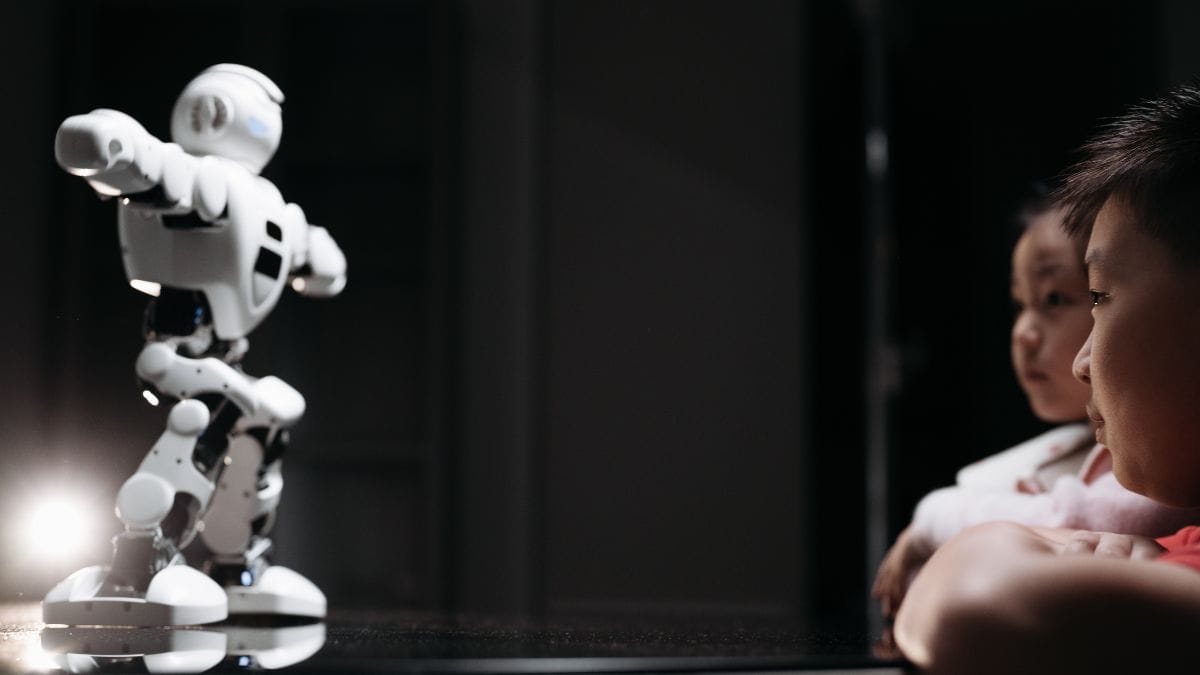
Discover what AI home robots can actually do in 2026, from cleaning and navigation to humanoid robotics and emerging household tasks.
AI home robots are moving beyond simple automation. Today’s consumer robots can already vacuum floors, mop surfaces, navigate rooms, avoid obstacles, and perform other specialized tasks, while newer systems are being developed to handle more complex household work. Technologies such as screenless AI gadgets are also exploring new ways for people to interact with AI without traditional screens.
The important distinction is that not every AI home robot is a general-purpose household assistant. Most consumer robots remain specialized machines, while robots that can manipulate objects, prepare food, handle laundry, or perform several chores are still an emerging area of robotics.
In this guide, we’ll look at what AI home robots can actually do in 2026, the technology behind them, which capabilities are mature, where the biggest limitations remain, and what could appear next.
What Are AI Home Robots?
AI home robots are robots designed to perform useful tasks in residential environments while using artificial intelligence to perceive, interpret, navigate, or interact with their surroundings.
Traditional household automation usually follows predefined rules. An AI- powered robot can use cameras, sensors, machine- learning models, computer vision, and other technologies to respond to changing conditions.
The International Federation of Robotics( IFR) classifies consumer service robots as robots intended for use by consumers without requiring a professionally trained operator. Its examples include domestic cleaning robots and social- interaction robots.
The term AI home robot can therefore cover several very different categories:
- Robot vacuums and mops
- Robotic lawn equipment
- Home- monitoring robots
- Companion robots
- Mobile home assistants
- Robotic arms and manipulators
- Emerging humanoid and general- purpose robots
This distinction matters because a robot vacuum and a humanoid household assistant may both use AI, but their capabilities are very different.
How AI Makes Home Robots Smarter
AI can help a robot understand its surroundings and decide how to respond to them.
Computer Vision and Object Recognition
Cameras and other sensors can help robots identify objects, people, furniture, rooms, and obstacles.
For example, a cleaning robot may use visual information to distinguish objects on the floor and choose a path around them.
More advanced robots mandate vision for another reason: they have to understand objects that they may eventually manipulate.
Autonomous Navigation and Mapping
Navigation is one of the most established capabilities in consumer robotics.
A home robot can create or use a map of its environment, determine where it is, and plan movement through rooms. Sensors can help it detect obstacles and adjust its route.
The challenge becomes much harder when the robot must operate in unfamiliar or constantly changing environments.
A home is not a factory floor. Furniture moves, people traverse around, pets create unexpected obstacles, and objects may be left in places where the robot did not expect them.
Natural- Language Interaction
More advanced AI systems can allow people to interact with robots using ordinary language.
Instead of selecting a rigid command, a user could potentially ask a robot to perform a task and have the system interpret the request before planning the physical actions required.
This connects robotics with technologies such as large language models, vision- language models, and other multimodal AI systems.
Physical AI
One of the biggest developments in robotics is the movement from AI that only generates information to AI that can act in the physical world.
Physical AI requires a robot to sense its environment, create decisions, move its body, manipulate objects, and respond to what happens next.
That is substantially more difficult than generating a text response because physical actions can fail in unpredictable ways.
Types of AI Home Robots
AI Cleaning Robots
Cleaning robots are currently the most established form of consumer home robotics.
Robot vacuums and mops can automate repetitive floor- cleaning tasks and use navigation technologies to move through a home.
Their advantage is specialization. Instead of trying to perform every household task, they are designed around a relatively narrow and well- defined job.
This makes them much easier to deploy than a general- purpose humanoid robot.
Companion and Home Assistant Robots
Companion robots focus more on interaction than physical household chores.
Depending on the system, capabilities can include:
- Voice interaction
- Social interaction
- Reminders
- Entertainment
- Home monitoring
- Communication features
These robots represent a different direction from cleaning robots because their value can arrive from interaction and assistance rather than mechanical labor.
General- Purpose and Humanoid Home Robots
Humanoid robots are the most ambitious category.
The idea is to erect a robot that can move through spaces designed for humans and use human- like arms or hands to manipulate objects.
This could eventually allow one machine to perform multiple tasks rather than requiring a separate robot for every chore.
Companies and research groups are working on capabilities involving household manipulation, cooking, cleaning, object handling, and other activities.
For example, LG introduced CLOiD at CES 2026 as an AI- powered home robot and demonstrated household scenarios involving tasks such as cooking and laundry. LG describes the system as part of its broader Physical AI and connected- home strategy.
However, demonstrations should not automatically be interpreted as proof that a robot can independently perform every demonstrated task in an ordinary home.
What Can AI Home Robots Actually Do in 2026?
The capabilities available today vary considerably by robot.
| Capability | Status in 2026 | Typical Example |
| Vacuuming | Mature | Robot vacuum |
| Mopping | Mature | Robot vacuum/ mop |
| Autonomous navigation | Mature and improving | |
| Mapping and route planning | ||
| Obstacle detection | Established | Cleaning robots |
| Home monitoring | Available in some systems | Mobile/ security robots |
| Voice interaction | Available | Companion and assistant robots |
| Object recognition | Increasingly capable | Vision- based robots |
| Object retrieval | Emerging | General- purpose robots |
| Moving household objects | Emerging | Manipulation robots |
| Laundry folding | Experimental/ emerging | Humanoid demonstrations |
| Cooking assistance | Experimental/ emerging | Research and demonstrations |
| General household autonomy | Early- stage | General- purpose robots |
The market data provides useful context here.
According to IFR’s World Robotics 2025 service- robot report, approximately 20.1 million consumer service robots were sold in 2024, with robots for domestic tasks accounting for about 97% of consumer service- robot sales in its dataset.
That means the home- robot market is already substantial, but most of those robots are still specialized domestic machines rather than human- like general- purpose assistants.
AI Home Robots You Can Buy vs. Robots Still in Development
One of the easiest ways to misunderstand home robotics is to treat every robot shown at a technology event as a consumer product.
There are several stages between research and widespread consumer availability:
- Research prototype, primarily developed to test a technology.
- Demonstration system, used to demonstrate what the technology can potentially accomplish.
- Early access or trials, deployed with limited users or in controlled environments.
- Commercial product, available to customers.
- Mass- market product, broadly available and supported at consumer scale.
This distinction is particularly important for humanoid home robots.
A company may demonstrate a robot folding clothes or manipulating kitchen objects without that robot being ready to perform those tasks reliably for thousands of households.
Recent robotics developments demonstrate the industry moving toward real- world deployment. Reuters reported in August 2026 that companies at China’s World Robot Conference were demonstrating humanoid systems for applications ranging from industrial work to household chores, while some companies were conducting home trials. The report also highlighted the industry’s challenge of moving beyond demonstrations toward useful, sustained real- world operation.
Key Technologies Behind AI Home Robots
Sensors, Cameras and Computer Vision
A robot needs information about its environment before it can establish useful decisions.
Depending on the design, that information may come from cameras and other sensors.
The robot can use this information to understand its position, detect objects, recognize obstacles, and determine where it should move.
Autonomous Navigation
Navigation involves more than simply moving forward.
A useful home robot needs to understand where it is, determine where it needs to go, and select a safe path.
This becomes particularly difficult when the environment changes.
AI Planning
A complex household request may involve several steps.
For example, a request such as putting an item away could require a robot to:
- Understand the request.
- Identify the object.
- Locate the destination.
- Navigate to the object.
- Pick it up.
- Navigate to the destination.
- Place it correctly.
- Confirm that the task was completed.
This is considerably more complicated than a single predefined robotic movement.
Robotic Manipulation
Manipulation is one of the biggest challenges for general- purpose home robots.
A vacuum cleaner only needs to move across a floor.
A household humanoid may warrant to pick up objects with different shapes, sizes, textures, and weights.
It may also warrant to establish drawers, handle doors, move containers, or interact with appliances.
Research at Stanford’s Robotics Center reflects this challenge. Its Domestic Suite recreates a studio- apartment environment for robotics research, including a kitchen where researchers investigate tasks involving cooking, cleaning, and organizing supplies.
What AI Home Robots Still Cannot Do Reliably
The biggest gap between today’s robots and the futuristic household assistant is general- purpose reliability.
A robot might successfully perform a task during a demonstration but still struggle when the environment changes.
Unpredictable Clutter
Homes are rarely perfectly organized.
Objects may be left on tables, floors, couches, or counters. A robot needs to identify what is important, what is movable, and what should be avoided.
Complex Cooking
Cooking involves many different types of objects, tools, ingredients, temperatures, and timing requirements.
A robot that can demonstrate a particular cooking sequence is not necessarily equivalent to a robot capable of independently preparing arbitrary meals.
Laundry
Laundry sounds simple, but clothing is physically difficult for robots because fabric changes shape.
Picking up a rigid object is generally easier than identifying, grasping, unfolding, and manipulating a flexible piece of clothing.
Stairs and Complex Spaces
Homes vary widely.
There are stairs, restricted hallways, different floor surfaces, furniture arrangements, doors, cabinets, and other physical obstacles.
A robot designed for one environment may not perform equally well in another.
Complete Autonomy
The ultimate goal is a robot that can receive a broad request and handle the entire task without supervision.
That remains a major challenge.
Stanford’s domestic robotics research specifically focuses on creating systems that can adapt to diverse living spaces and individual preferences, illustrating how much work is still required for practical household robots.
Benefits of AI Home Robots
AI home robots could provide several practical benefits as the technology matures.
Automating Repetitive Tasks
Cleaning is a good example because it involves repetitive work that can be standardized.
A robot can potentially handle routine tasks while people employ their time elsewhere.
Saving Time
Automation can reduce the amount of time people employ on certain household chores.
The greatest benefits are likely to appear from tasks that are repetitive, predictable, and physically tiring.
Helping People With Limited Mobility
Home robotics also has potential beyond convenience.
Robots could eventually assist people who have difficulty performing certain physical tasks.
The IFR categorizes care- at- home robots separately because these systems warrant to operate in more human- centric and unstructured environments and face higher safety and reliability requirements.
Smart- Home Integration
Future home robots could transform another layer of the smart home.
Instead of simply controlling a smart appliance, a capable robot could physically interact with that appliance.
LG’s CLOiD is an example of this direction, with LG describing integration between robotics and its ThinQ connected- home ecosystem.
Safety and Privacy Concerns
The more capable a home robot becomes, the more important safety and privacy progress.
Cameras and Microphones
A robot that can observe and hear its environment may collect information about a home and the people inside it.
Before buying a connected robot, consumers should review:
- What data the robot collects
- Whether data is stored locally or in the cloud
- How long data is retained
- Whether recordings can be deleted
- What accounts or services are connected
- Whether the manufacturer provides security updates
Physical Safety
A robot operating around people needs to handle unexpected situations safely.
This is especially important for robots with arms, moving parts, or the ability to convey objects.
Home Mapping
Navigation systems may create detailed representations of a home.
Consumers should understand how those maps are stored and used.
Privacy should therefore be treated as a major buying consideration rather than an afterthought.
How Much Do AI Home Robots Cost?
There is no single price range for AI home robots because the category includes very different products.
A practical way to assess about the market is:
| Category | Typical Position |
| Basic cleaning robots | Established consumer products |
| Premium cleaning robots | More advanced automation and sensing |
| Companion robots | Varies significantly by features |
| Mobile assistant robots | Smaller emerging market |
| Humanoid/ general- purpose robots | Mostly emerging and early- stage |
The price alone does not tell you how useful a robot will be.
A less expensive specialized robot can provide more reliable value for a specific task than a much more expensive experimental robot.
When comparing products, consider the total cost, including:
- Purchase price
- Subscription fees
- Replacement parts
- Maintenance
- Accessories
- Warranty
- Software support
Are AI Home Robots Worth Buying in 2026?
For many households, the answer depends on the task.
If you aspire automated floor cleaning, a specialized robot is already a practical category.
If you require a robot that can independently cook meals, fold laundry, organize your entire home, and perform unpredictable chores, the technology is much less mature.
A useful buying rule is:
Buy based on the task you need automated, not on how futuristic the robot looks.
AI home robots make the most sense when:
- The task is repetitive.
- The environment is relatively predictable.
- The robot has a proven track record.
- You understand its limitations.
- The maintenance requirements are reasonable.
Waiting may generate more sense when:
- You want general- purpose household assistance.
- The product is still primarily a demonstration.
- Availability is limited.
- The manufacturer has little real- world deployment history.
- You expect completely autonomous operation.
The Future of AI Home Robots
The long- term goal is not simply to generate better robot vacuums.
Researchers and companies are working toward robots that can understand instructions, navigate real environments, manipulate objects, and adapt to changing situations.
The AI side is advancing alongside robotics hardware.
The International Federation of Robotics notes that AI can help robots sense and respond to their environments and expand their range of functions.
Research is also moving toward robots that can perform increasingly complex tasks in human environments.
However, progress should not be confused with complete autonomy.
The most difficult part of household robotics is not making a robot move. It is making that robot reliably understand and manipulate an unpredictable home.
That is why the transition from specialized machines to general- purpose home assistants is likely to be gradual.
FAQs:
Question: What are AI home robots?
Answer: AI home robots are robots that use technologies such as computer vision, sensors, navigation, and AI models to perform useful tasks in residential environments.
Question: What can AI home robots do in 2026?
Answer: Current home robots can handle tasks such as vacuuming, mopping, navigation, obstacle detection, and some home-monitoring functions. More advanced systems are being developed for tasks like cooking, laundry, and object handling.
Question: Are AI home robots available to buy?
Answer: Yes. Specialized consumer robots, especially cleaning robots, are widely available. More general-purpose and humanoid home robots remain an emerging category, with some systems still focused on demonstrations and trials.
Question: Can AI home robots cook or fold laundry?
Answer: Some advanced systems have demonstrated cooking and laundry-related tasks. However, these demonstrations should not be treated as proof that general-purpose robots can reliably perform every household chore without supervision.
Question: Are AI home robots safe and private?
Answer: Safety and privacy depend on the specific robot. Buyers should check how cameras, microphones, home maps, and other collected data are stored, used, and protected before purchasing a connected home robot.
Question: Are AI home robots worth buying in 2026?
Answer: It depends on the task. Specialized robots can be practical for repetitive jobs such as floor cleaning, while general-purpose household robots are still developing. Consider reliability, capabilities, maintenance, privacy, and total cost before buying.
Key Takeaways
- AI home robots are already available, but most are designed for specific household tasks.
- Robot vacuums and mops remain the most established consumer home robots.
- AI helps robots with navigation, object recognition, environment mapping, and natural-language interaction.
- Humanoid and general-purpose home robots are still emerging and largely in development or demonstration stages.
- Tasks such as cooking, laundry folding, and object retrieval remain challenging for robots to perform reliably.
- Physical AI allows robots to move beyond digital assistance and interact with the physical world.
- Home environments are difficult because of clutter, pets, stairs, furniture, doors, and constantly changing conditions.
- Privacy and safety are important considerations for robots with cameras, microphones, home mapping, and physical movement.
- Buyers should consider availability, reliability, maintenance, subscriptions, and total cost, not just the robot’s features.
- The most practical approach is to choose a robot based on the specific task you want to automate.
Additional Resources:
- Stanford Domestic Robotics Research: Research on robots performing cooking, cleaning, and household tasks.